


How Jewellery Brands Use Film and TV Placement to Drive Real Sales
Global product placement spending hit $29.6 billion in 2023, growing at double-digit rates for four consecutive years, according to PQ Media's Global Product Placement Forecast. Over the same period, the global jewellery market reached $353 billion, projected to grow at 4.7% annually through 2030.
Brands across every category have worked out that a well-placed product in a film or series reaches audiences that advertising increasingly cannot. For jewellery brands, the opportunity is specific. A placed jewel does something a banner ad structurally cannot: it belongs to the story.
Here are six recent examples worth studying — and what each one signals for jewellery brands thinking about visibility.
1. Bvlgari — House of Gucci (2021): Archive Pieces as Character Armour
Ridley Scott's House of Gucci is a film about power dressed as fashion. Lady Gaga's Patrizia Reggiani — the woman who married into the Gucci dynasty and later ordered her husband's murder — uses her appearance as a weapon from the opening scene.
Costume designer Janty Yates sourced pieces directly from Bvlgari's archives, including a 1991 Bvlgari necklace in gold set with amethysts, citrines, pink tourmalines, emeralds, sapphires and diamonds — formerly part of the collection of Princess Yasmin Aga Khan — alongside a Bvlgari Tubogas bracelet, circa 1972, featuring cabochon amethysts and diamonds. Yates told Vogue:
"We didn't repeat a single item, not even an earring."
This is archival lending at its best. Bvlgari did not create a replica or commission a new piece. They opened their archive, and the result was jewellery that carried genuine history. The pieces were not decorative — they were biographical. The audience watched a woman arm herself for battle, and the jewels were part of that armoury.
After the film's release, fashion sites began reporting more 1980s-style jewellery, and auction houses recorded increased queries about similar bold gold pieces — a traceable shift in market interest that aligned directly with the film's period aesthetic.

2. Chopard — No Time to Die (2021): When Sustainability Becomes the Story
Bond films have always been a product placement vehicle — Aston Martins, Omega watches, Gordon's Gin. But No Time to Die marked the first time a couture jewellery house became an official partner of the franchise.
When Ana de Armas stepped onto screen as Paloma — a Cuban CIA agent written by Phoebe Waller-Bridge — she wore a Chopard diamond necklace set with 43 carats of pear-shaped diamonds, a bracelet comprising an 82-carat cascade of pear-shaped and brilliant-cut diamonds, and earrings set with 14 carats of diamonds. All three pieces were from Chopard's Green Carpet Collection — the first jewellery line made entirely from Fairmined certified gold and ethically sourced diamonds endorsed by the Responsible Jewellery Council.
The placement did two things simultaneously. It put Chopard's aesthetic — substantial, confident, diamond-forward — in front of one of the largest global film audiences of 2021. And it communicated the brand's sustainability credentials without a single word of copy.
Caroline Scheufele, Co-President and Artistic Director of Chopard, was deliberate about showcasing pieces that radiated what she described as an aura that is "as much ethical as aesthetic."

For any jewellery brand with an ethical sourcing story — and there are many — this is the instructive model. A screen placement in the right context communicates values faster than a press release.
3. Tiffany & Co. — Death on the Nile (2022): The Replica That Earns Its Own Fame
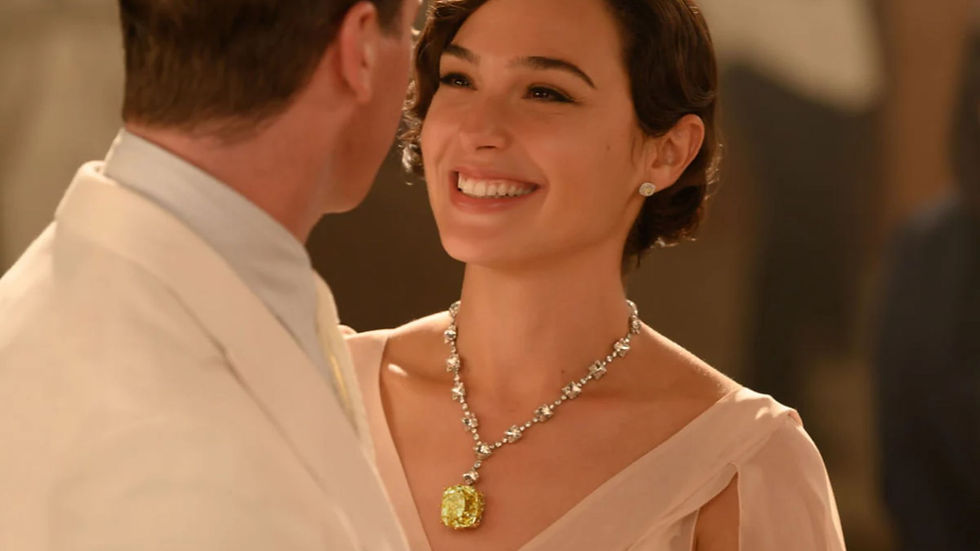
Kenneth Branagh's Agatha Christie adaptation gave Tiffany & Co. a brief, specific, and visually arresting placement. Gal Gadot's character, the fabulously wealthy Linnet Ridgeway Doyle, wears a necklace built around the most famous yellow diamond in the world.
The real Tiffany Diamond — a 128.54-carat Fancy Yellow cushion-cut stone unearthed in 1877 — is one of the world's largest and rarest yellow diamonds, valued at roughly $30 million. It has only ever been worn by four women, including Audrey Hepburn in 1961 and Lady Gaga at the 2019 Oscars. For the film, Tiffany created a faithful replica to adorn Gadot's character, bringing an air of authentic Old World luxury — and, in this context, deadly intrigue — to the screen.
The replica then went on display in Tiffany's New York flagship after production wrapped. The gem — even in facsimile form — generates press, foot traffic, and search volume each time it reappears in a new setting.
Kathryn Vanderveen, founder of Createology — a Los Angeles-based brand integration company with more than 20 years in film — draws a sharp distinction between red carpet dressing and in-film placement:
"The red carpet is not storytelling; it is showcasing, and the immediate impact fades quickly. Film integration is storytelling and marketing."
4. Jude Benhalim — Emily in Paris Season 5 (Netflix, 2025): Cairo Goes Global
In Season 5 of Emily in Paris, Lily Collins's Emily Cooper wears pieces from Egyptian jewellery house Jude Benhalim — including the brand's bestselling Mini Harmonia
Earrings and Elara Earrings, stacked alongside Mini Gemino styles. It marks the second consecutive season the Cairo-based brand has appeared in the series.
This placement is notable for two specific reasons. First, it proves that screen placement is no longer the exclusive territory of Paris, London, Milan, and New York. A brand founded in Cairo, with a distinct North African aesthetic, is reaching a global Netflix audience of millions — without a flagship store on the Rue du Faubourg Saint-Honoré, without a heritage dating back a century, and without a seven-figure marketing budget.
Second, it happened twice. A brand returning to a series in a subsequent season has moved beyond a one-off loan and into something closer to a sustained creative relationship. That is a different commercial arrangement, and a considerably more durable form of visibility.

5. Bulgari, Jemma Wynne, Jacob & Co. — The Devil Wears Prada 2 (2026): Jewellery as Character Arc
The Devil Wears Prada 2 opened in May 2026 and earned $433.2 million globally in its first two weeks, including $288.4 million at the international box office. The studio described its marketing campaign as the largest in Disney's history by number of official brand partnerships, with contributions valued at $250 million.
The jewellery placements inside the film are among its most deliberate storytelling choices.
Anne Hathaway's character Andy Sachs begins the film in relatively restrained pieces — a Jemma Wynne Forme emerald-cut diamond toggle pendant necklace ($23,730) and Marlo Laz gold hoops with old-mine diamonds ($22,000). As her character's status rises through the film, so does the jewellery. By the later scenes, Andy is wearing Bulgari — for which Hathaway is a real-life brand ambassador — with the character arc quite literally tracked through the pieces on her wrist and neck.
Meryl Streep's Miranda Priestly wears pieces by Briony Raymond and David Yurman throughout. For the film's climactic fashion show sequence in Italy, costume designer Molly Rogers reached for Jacob & Co.'s Infinia earrings set with baguette rubies — pieces that, in their diamond version, sell for over $250,000. The Ruby versions worn on screen are no longer available.
Emily Blunt's character, meanwhile, receives Tiffany & Co. jewellery as a gift from her billionaire tech boyfriend — a single prop choice that communicates an entire relationship dynamic without a word of dialogue.

This is what mature jewellery placement looks like. Multiple brands at different price points are each doing different narrative work within the same film. The pieces are not styling accessories — they are instruments of characterisation.
6. Autore Pearls — Bridgerton (Netflix, 2020–present): The Quiet Placement That Built a Category
Bridgerton is a Regency-era romance built on drama, costumes, and social hierarchy. The jewellery is part of that world — specific, period-appropriate, and visually considered.
Autore, an Australian South Sea pearl specialist, supplied pearls to the production. The pieces appear on screen as the sort of jewellery that the characters would naturally own.
No character names the brand. No scene is built around the pieces. They are simply present in the world of the show — worn by women whose status, taste, and social position they silently communicate.

The Bridgerton approach — sometimes called "earned placement" — works differently from a partnership built around a single hero piece. The brand does not get a spotlight moment. It gets something arguably more durable: repeated visual association with an aspirational world across multiple seasons and millions of hours of viewing.
Kathryn Vanderveen of Createology, who negotiated smaller production integrations including Autore's Bridgerton placement, views this kind of deal as "cost-effective, high-impact marketing that should be at the top of every luxury brand's list." She is specific about the difference in longevity: a film or series integration becomes part of a cultural memory that the red carpet cannot replicate.
When Bridgerton returned for its subsequent seasons, Autore's South Sea aesthetic was already embedded in the visual language of the show. The brand did not need to renegotiate its position from zero.
What This Means if You Are Building a Jewellery Brand Today
Most jewellery brands reading this will not place a piece in a Bond film or dress Anne Hathaway for a $433 million sequel next quarter. That is realistic. But the principles in these six cases apply at every scale.
The question that every example above answers — before any director or costume designer gets involved — is this: does this piece have a clear, consistent visual identity that can carry meaning when separated from a brand name or a caption?
If a piece is poorly documented, inconsistently photographed, or visually undefined, screen time will not generate demand. A costume designer cannot use a blurry product shot. A press contact cannot write around inadequate imagery. A buyer cannot forward an image that does not communicate the piece.
At Chocianaite, we work with independent jewellery brands on the visual infrastructure that makes this kind of visibility viable: photography that communicates a piece's texture, weight, and character; brand identity work that gives a collection a legible visual language; and content that ensures pieces are documented in a way that opens doors — whether that door leads to a costume department, a press desk, or a wholesale buyer.
A brand that is ready for placement has invested in how its pieces look before the opportunity arrives. A 1:1 Visual Audit identifies exactly where the gaps are.


Comments