


Inside Google Ads for Fine Jewellery Brands: What We Learned With Ema Markesic
On 26 June, I hosted a live webinar with Ema Markesic, founder of the performance marketing agency Emand and a Google Ads Solutions Expert at Google, where she supports companies including Inditex and Puig. Over two hours, Ema and I worked through what fine jewellery founders actually need to understand before they spend a pound on paid search.
The number that reframed the room
Early on, one figure did most of the work. According to Boston Consulting Group, companies that link all of their first-party data sources can generate double the incremental revenue from a single ad placement, communication, or outreach, compared to brands with limited data integration.
For a fine jewellery brand, that is not abstract. It is the difference between an account that scales and one that stalls. With third-party cookies fading, the customer data you already own — email lists, phone numbers, purchase history — is becoming the engine, not the side dish.
Why the fine jewellery buyer changes everything
Before any campaign type came up, Ema explained who was actually clicking the ad.
Three traits define them:
High stakes. Fine jewellery purchases are tied to proposals, anniversaries, and milestone gifts. They are emotional and rarely impulsive.
Trust before transaction. Ads bring traffic. The website has to carry the luxury experience and earn confidence before anyone spends four figures.
A long road to purchase. An engagement ring journey can run for months across many touchpoints. A single click almost never closes the sale.
As Ema put it during the session:
"Fine jewellery is bought at the biggest moments in people's lives. Nobody buys an engagement ring on impulse from one ad. Your job is to be there across the whole decision, not to win it in a single click."
That last point creates a measurement problem most brands never see coming.
The measurement trap behind long sales cycles
Here is the operational issue, stated plainly. Google's most effective bidding strategy, Maximise Conversion Value, needs roughly 30 conversions per month to learn. A jewellery brand selling a handful of high-value pieces each month will never feed it enough purchase data.
The fix Ema raised was to stop treating the final sale as the only conversion. Assign proxy values to micro-conversions — an Add to Cart, a contact form, a booked consultation — so the algorithm has enough signal to optimise against.
Conversion type | Volume per month | Useful for AI bidding? |
Completed purchases only | 2–8 (typical) | No — too sparse |
Purchases + micro-conversions | 30+ | Yes |
Without this step, "Maximise Conversion Value" simply cannot run. With it, the same low-volume brand becomes trainable.
"The algorithm needs to be fed. If your only conversion is a sale and you make six a month, you're asking Google to learn from almost nothing. Give it the smaller signals along the way and it starts to work for you." — Ema Markesic
The safe funnel: where to start, and in what order
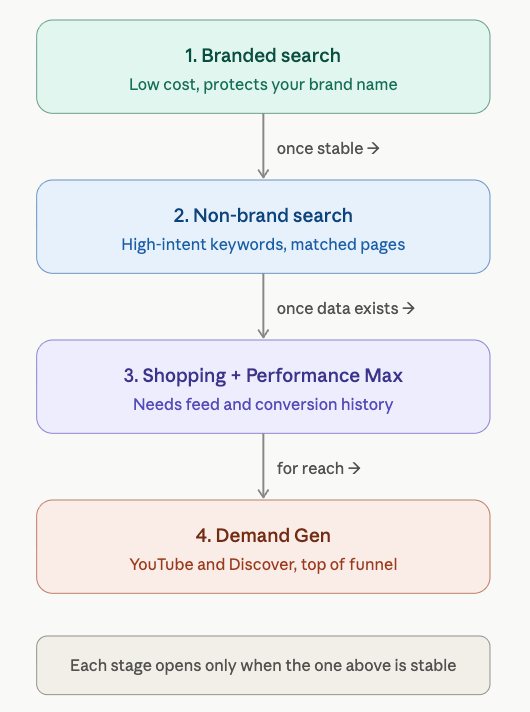
A recurring mistake, Ema noted, is launching Performance Max or Shopping on day one. She laid out a sequence instead:
1. Branded search first
A campaign targeting your own brand name. Low cost, high return, and it stops competitors from buying traffic that was already looking for you.
2. Non-brand search, tightly targeted
High-intent, long-tail keywords such as "18K yellow gold diamond eternity ring". Each keyword should land on a matching category page — never a generic homepage.
3. Shopping and Performance Max — only once stable
Visual campaigns come after the search foundation holds. Performance Max needs significant historical conversion data and is wrong for a new account. Shopping depends on a rich, optimised Merchant Center feed to show up at all.
4. Demand Gen for awareness
A visual campaign across YouTube and Discover, suited to the top of the funnel rather than immediate sales.
The logic is cumulative: protect the brand, capture intent, then expand into visual reach once the data exists to support it.
First-party data: the part most brands skip
This came back to that opening BCG figure. First-party data is information collected directly from your customers — sign-ups, purchase history, website interactions — with consent. Uploaded into Google as a customer list (email, phone, postcode), it lets the AI find similar high-value users.
Two practical starting points came up:
No data yet? Run lead-generation campaigns first to build an email and phone list before scaling anything.
On Shopify? Use the official Google Shopify app to sync conversion actions cleanly, rather than relying on patchy manual tracking.
Third-party cookie data, by contrast, is on its way out. Building your own data is the durable move.
"Third-party tracking is disappearing, and a lot of brands are panicking about it. The brands who'll be fine are the ones who started collecting their own customer data early. That list is your most valuable marketing asset." — Ema Markesic
Budget: the honest thresholds
No vague guidance here. Ema gave working numbers. For the US market, roughly $5,000 per month is the baseline to see meaningful results across campaign types. On a smaller budget — around €20–50 per day — the advice was to spend it all on a branded search campaign rather than spread it thin.
Budget level | Recommended approach |
~$5,000/month minimum | Baseline to see meaningful results across campaign types |
€20–50/day | Spend exclusively on a branded search campaign |
Below the minimum, splitting budget across Shopping, PMAX, and non-brand search dilutes everything. A single well-run branded campaign does more with small money than four half-funded ones. As Ema noted, budget alone is never the full story behind performance — structure and measurement matter just as much.
Creative: clarity beats beauty
"Creative" covers both ad copy and visuals. The principle that landed: a clear product shot outperforms a beautiful but unclear lifestyle image. The buyer wants to see the piece.
For video, Ema used Google's ABCD shorthand:
Attention — logo in the first 2–3 seconds
Branding — integrate the brand naturally
Connection — tell a story
Direction — clear call to action and logo at the end
"You can have a perfect campaign structure and still lose if the imagery is weak. With jewellery, the photo is the product. If people can't see it clearly, they don't click, and if they do click, they don't buy." — Ema Markesic
Where the creative side tends to break
Most of the advice above assumes you already have product imagery good enough to convert a four-figure buyer. In practice, that is where many jewellery brands stall. The Merchant Center feed needs rich, consistent product shots. The non-brand landing pages need imagery that signals luxury within seconds. Weak photography quietly caps the return on every pound of ad spend.
This is the gap Chocianaite works in. We produce product, model, and AI-assisted jewellery photography built specifically for paid channels — clean product clarity for Shopping feeds, lifestyle and campaign assets for Demand Gen and social, and creative direction that keeps it consistent with your brand system. If your ads are technically sound but the click-through-to-purchase is soft, the creative is usually the lever. You can talk to us about a shoot here.
Why act on this now
Third-party cookies are being phased out across the ad ecosystem, and the brands building first-party data today are the ones whose accounts will still perform in a year. The order of operations matters too: a healthy one-year account — stable branded and non-branded search, an optimised Shopping campaign, and a remarketing layer — is built in sequence, not overnight. Starting the branded campaign and the data collection now is what makes the rest possible later.
In short
Ema's message was straightforward: respect how the jewellery buyer actually behaves, fix your measurement before you chase fancy campaign types, build the data you own, and don't let weak creative cap a sound account. Start narrow, prove it works, then expand.
To be first to hear about the next session, follow along through our community or get in touch. The full webinar video is available for the premium Ultimate Jewellers' Playbook members.


Comments