


AI Model or Real Model? What Jewellery Brands Should Choose for Model Photography in 2026
The AI-generated fashion photography market grew from roughly $1.51 billion in 2024 to $2.01 billion in 2025, driven almost entirely by brands replacing studio shoots with virtual photoshoots and digital models.
H&M, for one, now runs digital twin models for high-volume product content, while keeping human models for premium campaigns.
Jewellery brands are asking the same question fashion asked two years ago: should the next campaign feature a hired model, or an AI-generated one?
The honest answer depends on what the campaign needs to do, what your production budget looks like, and — increasingly — what the law allows. Here is how to make that decision with actual criteria.
Why This Decision Matters More for Jewellery Than for Fashion
A t-shirt photographed on an AI model reads fine at thumbnail size. Jewellery behaves differently under scrutiny.
Buyers zoom. They inspect the clasp, the prong setting, the way light moves across a polished band. Generative models have historically struggled with exactly these details — stone facets, metal reflections, hallmark stamps — because reflective micro-surfaces are the hardest thing for image models to render convincingly. A plausible-looking ring that falls apart at 200% zoom costs you the sale and, worse, the trust.
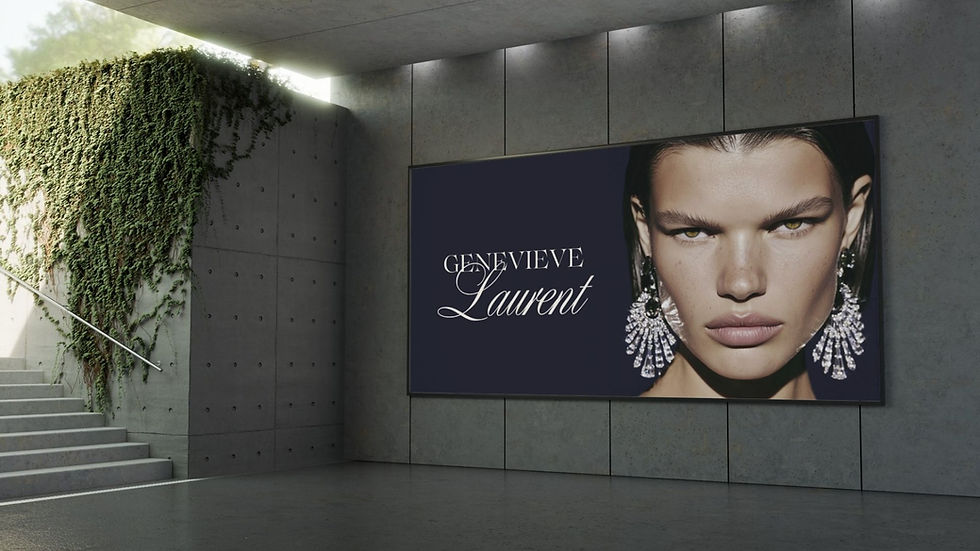
At the same time, on-model imagery is one of the strongest conversion drivers in the category. Adding photos of models wearing products can increase conversions by up to 34%, and 78% of fine jewellery purchases are influenced by seeing pieces worn by another person. A customer buying a £380 ring is buying an image of herself wearing it.
So skipping model photography altogether is the one option that reliably underperforms. The real decision is how you produce it.
AI Model vs Hiring a Model: The Arguments That Actually Matter
1. Trustworthiness
A real model is, by default, trusted. The buyer knows a real person is wearing the piece, and that trust transfers to the product.
An AI model can reach the same trust level, but only under one condition: the image must be good enough that no buyer can tell it is AI-generated. A visibly synthetic face, an unnatural hand, or an inconsistent shadow breaks that trust immediately, and once broken, it extends to the product itself. Poor-quality AI imagery does not read as "efficient." It reads as cheap.
The practical rule: AI model photography is only trustworthy at a quality bar high enough to be indistinguishable from a real photograph. Below that bar, it is a liability, not a saving.
2. Price
Real models come with a full cost stack: day rate, agency commission, photographer, studio hire, styling, and usage licence renewals if the images stay live beyond the contracted term. A single shoot day with a professional model in the UK or EU commonly runs into four figures before post-production is even counted.
AI model generation removes the shoot day, the agency fee, and the licence renewal. You pay for generation and compositing time, and you own the output outright.
3. Environment and Styling Freedom
A real photoshoot is bound by what actually exists: the studio you booked, the location you can travel to, the outfits you sourced, the weather on the day. Changing the backdrop after the fact means a reshoot.
AI generation removes that constraint. The same model face can be placed in a desert, a marble interior, or a beach at golden hour, in any outfit, without booking a single additional location or garment. For brands producing seasonal or market-specific variants of the same core imagery, this is a genuine operational advantage.

4. Authenticity and Margin for Error
Real models carry fewer failure modes. A trained model knows how to hold a hand, angle a wrist, and wear a ring so the stone catches light correctly. The error rate on a professional shoot is low, and what errors occur are fixable in standard retouching.

Photoshoots for Life Charms 
Photoshoots for Life Charms 
Photoshoots for Life Charms
Photoshoots for Life Charms with real models capture genuine emotions, natural movement, and authentic interactions. They also showcase bracelet stacks and intricate jewellery details with a level of precision that AI still struggles to recreate without losing accuracy.
AI generation still makes jewellery-specific mistakes: an extra prong, a wrong clasp, proportions that shift slightly between one generated image and the next. These errors are less visible on a t-shirt and highly visible on a diamond setting.
Quality control on AI output has to be stricter for jewellery than for any other product category, because the margin for a visibly wrong ring is smaller than the margin for a slightly odd sleeve.
5. The Legal Aspect: What You Can and Cannot Do
This is the criterion with the least room for interpretation.
With a real model, a signed contract defines exactly what you are allowed to do: which images, which channels, for how long. Stay inside that contract, and you are on solid ground.
What you cannot do, unless it is mentioned in the contract, is feed a real model's photographs into an AI tool to generate new images of her. Even with a valid shoot contract, that contract covers the shoot itself. It does not cover synthetic reproduction of her likeness in scenarios she never posed for.
An AI-generated face created entirely from scratch, without using any real person's photo as a reference, can generally be used commercially and does not require a model release. However, if you use AI-generated models in your social media content or advertising, you may need to disclose that the image was created with AI, depending on the platform or local regulations. Keep in mind that some audiences react negatively to AI-generated people, so transparency may also influence how your brand is perceived.

Five Operational Differences Between AI Models and Real Models
Factor | Real model | AI model |
Buyer trust | High by default | High only if indistinguishable from a real photograph |
Cost structure | Day rate, agency fee, studio, styling, licence renewal | Generation and compositing time, no renewal fees |
Creative range | Limited to what was actually booked and shot | Any setting, any styling, without a reshoot |
Error profile | Low; a trained model wears jewellery correctly by default | Prone to jewellery-specific errors: wrong hand, extra finger, a clasp that would not physically close |
Legal position | Governed entirely by the signed usage contract | Legal only if the face was generated from scratch, with no real person's photograph used as a reference |
Where a Production Partner Fits
Running both routes correctly, at the same time, without crossing the legal line, is an operational skill most in-house teams do not have by default. It requires jewellery-specific AI expertise, standard photography production, and a clear compliance boundary between the two.
At Chocianaite, we produce both real jewellery photography and AI-generated model imagery, with that boundary built into how each project is scoped from the start.
Our AI model images are generated from text prompts, without face references of real people, so the legal risk in criterion five never enters the workflow.
Both routes are legitimate. AI model photography wins on consistency, volume, cost, and turnaround — and current tools produce genuinely editorial quality when operated with jewellery-specific expertise. Real models win on emotional depth for hero campaigns and founder storytelling. The one route that is closed to you is hybridising a real person through AI without explicit, documented consent.
Choose deliberately, document the choice, and keep the two workflows separate. That is the entire strategy.


Comments